-
Cause and effect applies to us all, consider therefore your thoughts, words and actions carefully. -
School found in prehistoric cave in Israel
'School of Rock' Found in Prehistoric Cave in Israel
Archaeologists may have uncovered the oldest known prehistoric school, where it seems young hominins were taught how to make flint tools, butcher animals, and master other skills necessary to survive in the Stone Age about 400,000 years ago. The discovery is so remarkable that the scientists are wondering whether it means Homo sapiens itself evolved much earlier than is currently thought.
The notion that what they found was evidence of an early teaching system is based on analysis of hundreds of flint stones and fragments found in Qesem Cave, in central Israel, a spot that hominins called home from 400,000 to 200,000 years ago.
The discovery may attest that our ancestors developed complex cultural patterns, such as language and knowledge transmission, much earlier than believed. That in turn adds to mounting evidence from around the world that has already pushed back the clock on the evolution of modern humans by at least 100,000 years, and challenged the idea that Homo sapiens developed in Africa.
?I wouldn?t talk about a school in the modern sense, but we can see a specific tradition, a specific way of doing things in the cave, which was passed on from generation to generation,? says Ella Assaf, an archaeologist and PhD student at Tel Aviv University who is leading the study. ?There was definitely a mechanism of knowledge transmission.?
Assaf, who has been digging at Qesem since 2010, analyzed hundreds of flint items looking for signs of different skill levels by the prehistoric knappers.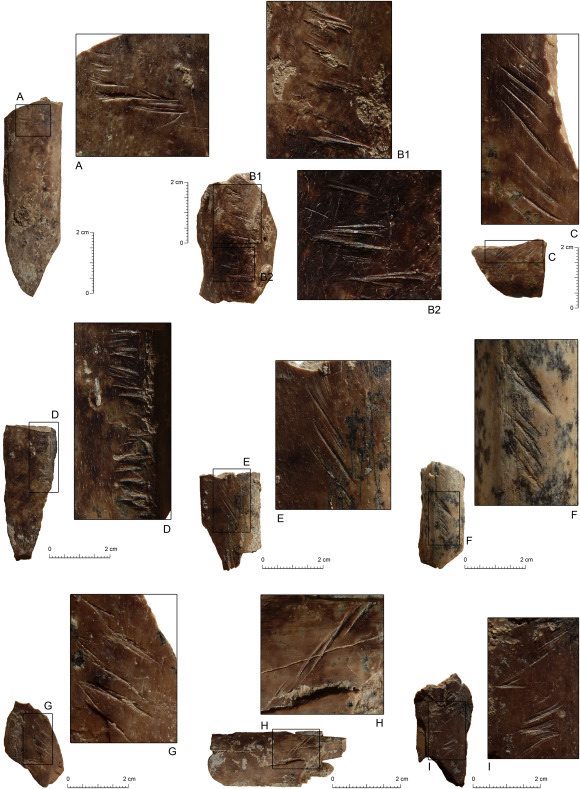
Limb bones of animals found in Qesem Cave,
where primitive men of some type lived, and
made and used flint tools - Courtesy of Ruth
Blasco and Jordi Rosell
?Knapping is complex. It requires many different motor and cognitive skills, as well as technical and practical knowledge,? she told Haaretz. ?The idea was to see if we can identify the different stages in this learning process."
Among the most telling finds are flint cores that show signs of having been used by multiple people, some of whom were clearly highly skilled, while others were just beginners, Assaf explains.
The discovery of what seems to be a school for advanced flint tool-making raises the key question of how this prehistoric show-and-tell took place. Did the hominins who lived so long ago already have a language with which to teach their children? Can such complex behavior be learned just through imitation?
When our ancestors began to talk is controvesial. Some researchers suggest that, at least physiologically, they may have already been speaking as early as 1.75 million years ago, as they began to create more complex and standardized tools, which required some kind of knowledge sharing.
We don't know who lived at Qesem itself. Only a handful of teeth have been recovered, not enough to conclusively determine what kind of hominin inhabited the cave. Even so, experts have pronounced the teeth to be much more similar to those of Neanderthals and Homo sapiens than to those of Homo erectus, the first hominin known to have left Africa and spread across Eurasia some 1.8 million years ago.
What does all this mean? Did humans first evolve in North Africa? In the Middle East? In China? Or perhaps there are even older remains of Homo sapiens just waiting to be discovered in the African heartlands?
Assaf says that at this stage it?s impossible to answer such questions, but it seems that many of the things that make us human ? the ability to plan ahead, to shape our environment, to create complex and enduring societies ? appeared much earlier than we previously thought.
-
Re: Anient teeth found in Israeli cave?
Oldest Homo sapiens bones ever found shake foundations of the human story
Bron theguardian.com
Idea that modern humans evolved in East Africa 200,000 years ago challenged by extraordinary discovery of 300,000-year-old remains in Moroccan mine
Fossils recovered from an old mine on a desolate mountain in Morocco have rocked one of the most enduring foundations of the human story: that Homo sapiensAnthropologyJebel Irhoud has thrown up puzzles for scientists since fossilised bones were first found at the site in the 1960s. Remains found in 1961 and 1962, and stone tools recovered with them, were attributed to Neanderthals and at first considered to be only 40,000 years old. At the time, a popular view held that modern humans evolved from Neanderthals. Today, the Neanderthals are considered a sister group that lived alongside, and even bred with, our modern human ancestors
The first almost complete adult mandible discovered
at the site of Jebel Irhoud. The bone morphology and
the dentition display a combination of archaic and
evolved features.
Scientists have long looked to East Africa as the birthplace of modern humans. Until the latest findings from Jebel Irhoud, the oldest known remnants of our species were found at Omo Kibish in Ethiopia and dated to 195,000 years old. Other fossils and genetic evidence all point to an African origin for modern humans.
In the first of two papers published in Nature on Wednesday, the researchers describe how they compared the freshly-excavated fossils with those of modern humans, Neanderthals and ancient human relatives that lived up to 1.8m years ago. Facially, the closest match was with modern humans. The lower jaw was similar to modern Homo sapiens too, but much larger. The most striking difference was the shape of the braincase which was more elongated than that of humans today. It suggests, said Hublin, that the modern brain evolved in Homo sapiens second paper, the scientists lay out how they dated the stone tools to between 280,000 and 350,000 years, and a lone tooth to 290,000 years old.
The tools found were based on a knapping
technique called Levallois, adding to the
realisation that the sophisticated way of
shaping tools originated earlier than thought.
Homo sapiens
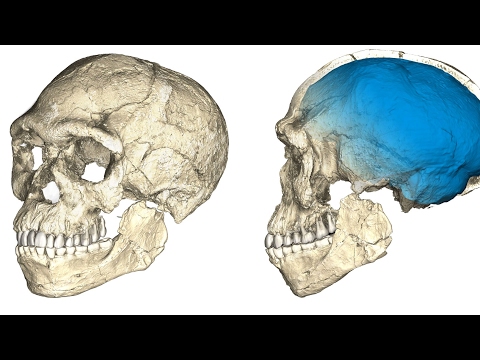
Two views of a composite reconstruction of the
earliest known Homo sapiens fossils from Jebel
Irhoud The braincase (blue) indicates that brain
shape, and possibly brain function, evolved
within the Homo sapiens lineage.
300,000 year-old Homo naledi Homo sapiensComment


 Tweet
Tweet


Comment