Wendag
 Wendag
- Tertium OrganumTertium


Wendag
Debat oor Christendom en Godsdiens
Tertium Organum
by P.D. Ouspensky, [1922].
Chapter XXV
[p. 337]Table of the Four Forms of the Manifestation of Consciousness
THE SENSE OF SPACE AND TIME
1ST FORM
The sense of one-dimensional space. The world on the line. The line as space, everything else as time. Everything except things lying on this line is in motion.
2ND FORM
The sense of two-dimensional space. The world on the plane. The plane as space, everything else as time. Angles and curves as motions.
3RD FORM
The sense of three-dimensional space. The world in an infinite sphere. The sphere as space. Everything else as time. Phenomena as motions. A becoming and changing universe.
4TH FORM
The sense of four-dimensional space. Spatial sensation of time.
PSYCHOLOGY
1ST FORM
Appearance of the first sensation. Sensation a unit. Its division into two. The gradual evolution of sensations and the accumulation of remembrances concerning them.
2ND FORM
Perception. The expression of sensations by cries, sounds, motions. The absence of words and speech. Were there speech it would consist of substantives only.
3RD FORM
Concept.
Words.
Judgment.
Syllogism.
Reasoning.
Speech.
Written language.
Allegory.
Emotions.
4TH FORM
Self-consciousness.
New sensations.
Higher emotions.
Expansion of concepts.
Direct knowledge.
Symbolism.
Cosmic consciousness.
LOGIC
1ST FORM
The absence of thinking, or a confused thinking of the 2nd form.
2ND FORM
This is this.
That is that.
This is not that.
The beginnings of logic. The logic of the uniqueness of each separate thing.
3RD FORM
A is A.
A is not Not-A.
Everything is either A or Not-A.
Dualistic logic.
A logic of antitheses.
Syllogism.
4TH FORM
A is both A and Not-A.
Tat twam asi. Thou art that.
"Tertium Organum."
Logic of the unity of all.
MATHEMATICS
1ST FORM
The absence of numeration, or a confused numeration of the 2nd form.
2ND FORM
The comparison of separate visible objects or separate perceptions. The direct sensation of quantity. Computation within the limits of this sensation.
3RD FORM
Every magnitude is equal to itself. The part is less than the whole, etc.
Finite and constant numbers. The geometry of Euclid.
4TH FORM
A magnitude can be not equal to itself. The part can be equal to the whole, etc.
Metageometry.
Mathematics of variable and infinite magnitudes.
FORMS OF ACTIONS
1ST FORM
Reflex, unconscious, responsive action to external irritation.
2ND FORM
Instinct. "Emotional" end expedient action without consciousness of results.
Seeming consciousness.
Inability to manipulate a lever.
3RD FORM
The consciousness of the purpose of actions performed. The possibility of a consciousness of results. The cause of actions in the outer world in impressions received from the outer world. The impossibility of in dependent actions without impulses coming from the outside.
4TH FORM
The starting of conscious actions.
The starting of actions with the understanding of their cosmical meaning and purposes.
The commencement of independent actions proceeding from oneself.
MAGIC.
MORALS
1ST FORM
Unconscious actions (like the actions of a man asleep).
2ND FORM
The beginnings of the maternal, family, and tribal instincts.
Laws of the life of the species as a condition of evolution.
he unconscious submission to the "group soul" of the species manifesting through instincts.
3RD FORM
Logical and conventional division into good and evil.
The submission to the group consciousness of the family, of the clan, of the tribe, of the nation, of humanity, of the class, of the party, of a custom, of a fashion, etc.
4TH FORM
The return to the law inside oneself.
A new conscience.
Emancipation from submission to the group-consciousness.
The realization of oneself as an independent unit.
FORMS OF CONSCIOUSNESS
1ST FORM
Potential consciousness.
Consciousness in a latent state—asleep.
Consciousness as in sleep without dreams.
2ND FORM
Simple consciousness.
"It pains me," but the impossibility of saying, "I am conscious that it pains me."
The reflected state of consciousness.
Vision as in dreams.
The passive state of consciousness.
3RD FORM
The ability to think of one's states of consciousness.
The division of I and Not-I.
Active consciousness.
The moment when further evolution can be conscious only.
4TH FORM
The commencement of self-consciousness.
Ecstatic states.
Transitions to cosmic consciousness.
FORMS OF KNOWLEDGE
1ST FORM
Unconscious receptivity of the environment, and unconscious reaction to it.
"ADAPTABILITY."
2ND FORM
The beginnings of attention. Observation.
The accumulation of instincts.
The recognition of everything sensed as real.
The failure to discriminate between that which is illusory and that which is real.
3RD FORM
Experience.
Experimental knowledge.
A complete and deep division and mutual misunderstanding between four forms of knowledge—religion, philosophy, science and art.
4TH FORM
The beginning of the development of forms of knowledge.
Mystic knowledge.
A new sensation of time.
The sensation of infinity.
The sensation of the unreality of the phenomenal, visible world.
A knowledge of the hidden substance of things by their outer signs.
Unfoldment of the "world of the wondrous."
Co-ordination in a complete whole of religion, philosophy, science and art.
FORMS OF SCIENCE
1ST FORM
An accumulation of "traces" from the produced reflexes.
The appearance of instinct and the accumulation of simple instincts.
2ND FORM
Personal knowledge.
Impotence to communicate experience.
The beginnings of the communication of experience in the training of the young.
3RD FORM
Positive science.
Positive philosophy.
Materialism.
Spiritualistic philosophy.
Dogmatic religions.
Spiritism and pseudo-occultism.
Sectarianism.
Dualism.
Matter and spirit.
Separation of different forms of science.
4TH FORM
Idealistic philosophy.
Mathematics of the infinite.
Tertium Organum.
Mystical religion.
God and the Cosmos—one.
The sensation of a living and conscious universe.
The union of all sciences into one.
Occultism.
Understanding of "Dharma," i.e., of laws of relativity.
DIFFERENT BEINGS
1ST FORM
The lower animal.
Cells of the tissues and organs of the body.
The one-dimensional being.
Vegetative or semi-vegetative life.
2ND FORM
The higher animal.
The body of man.
The two-dimensional being.
The absence of duality, divisibility and disharmony.
Animal life.
3RD FORM
Man.
A three-dimensional being outwardly and dual inwardly.
Inner warfare.
The impossibility of attaining inner harmony.
The "soul" as the battlefield of the "spirit" and the "flesh."
The kingdom of the personal. Unconscious automatism.
The absence of personal immortality.
4TH FORM
The beginnings of the transition to a new type, and a new sensation of space.
Victory of consciousness.
"Men of cosmical consciousness."
Triumph of the super-personal principle.
Conscious automatism.
The attainment of inner unity and harmony.
The "soul" as the center of independent actions, The beginnings of personal immortality.
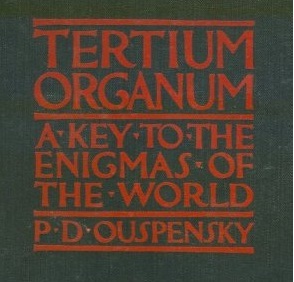
TERTIUM ORGANUM, The Third Canon Of Thought, A Key To The Enigmas Of The World by P. D. OUSPENSKY